Overview
Whether or not making movies has ever been your goal, everyone knows that some film achievements that are just the dream. Getting into SXSW is one of them. If you're from Australia, and from Sydney at that, having your first feature play at Sydney Film Festival ranks as highly. Amy Wang has now notched up both thanks to Slanted, which premiered at Austin's OG version of SXSW in March, then made its Aussie debut at SFF.
Was this the dream for Wang? "100 percent. Yes. Yes. Growing up — and I went to film school here in in Sydney as well — there are those film festivals like the Cannes, the Sundances and SXSWs, where you're just like 'wow, even to just play'," she tells Concrete Playground. "I think they choose ten films or eight films to play in competition at South By. I remember that day. I had a friend who had a film that played at South By the previous year, and they had said they got their acceptance email around the beginning of December. So I just had this inkling. I was like 'if I don't get this email today' — it was a Friday — 'then it's probably a no go'. And I got it. It was so surreal for sure. Just so happy."
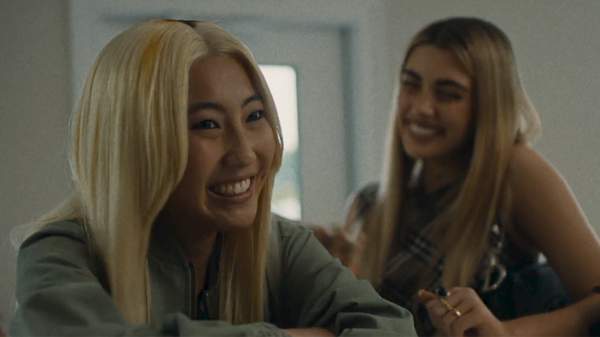

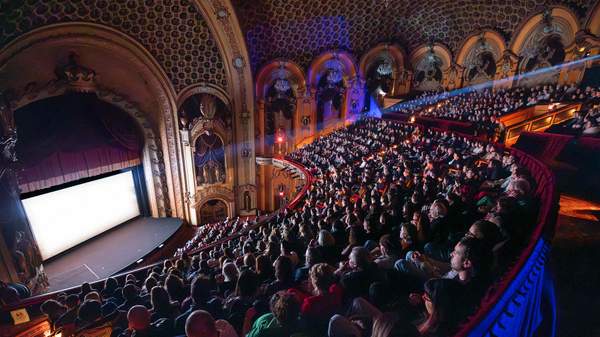
That's how Wang discovered that she'd be unveiling her body-horror satire about a Chinese American teen's desire to be like her peers at her US high school — plus the lengths the character goes to to achieve that aim — in America. For her troubles, she took home 2025's SXSW Narrative Jury Award. Playing Sydney Film Festival is another treasured milestone. "In many ways, I am even more excited to show it in Sydney," she notes. "Growing up in Sydney, I would go to Sydney Film Festival every year since I was a teenager. So I've been to the State Theatre so many times, lined up outside. It's such a prestigious venue."
Slanted's first Aussie session did indeed play at the grand venue at the heart of SFF. It's a US-set and -made film, but screening in Australia is a homecoming because its Chinese Australian writer/director has taken inspiration from her childhood experiences right here. The story of Joan Huang (Shirley Chen, Dìdi) isn't far from Wang's own growing up, when she was teased and attacked due to her race, she advises. Well, that setup has its parallels, at least. With Slanted, the filmmaker takes that trauma and transfers it into a world of prom queens and blonde obsessions, crafting a biting exploration of such a nightmare — one where Joan is convinced that the radical step that is "racial transformation surgery" is her only choice.
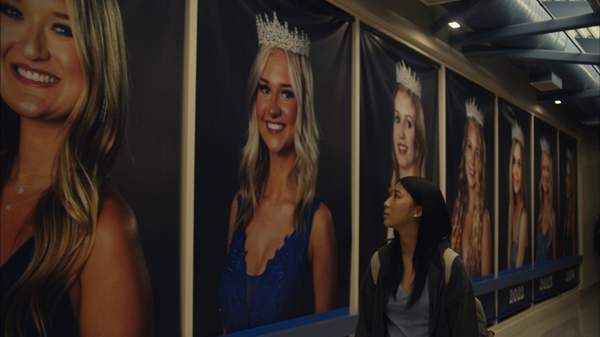
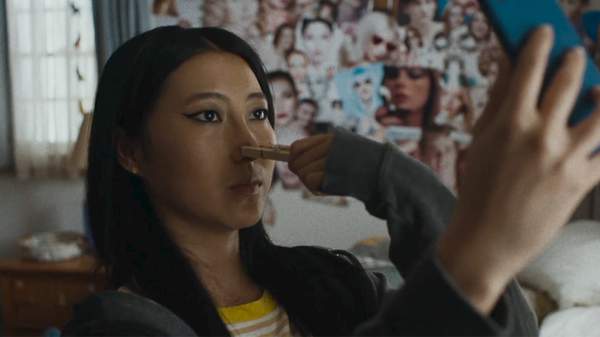
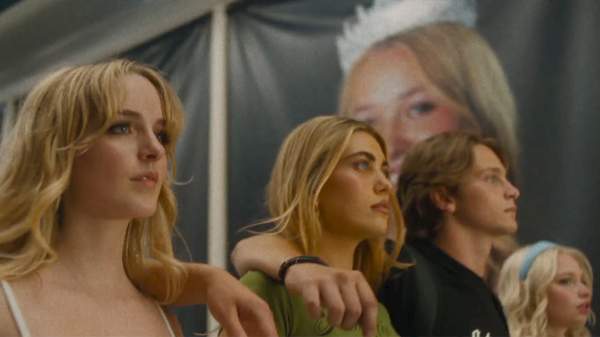
When Joan walks her school's halls, she strolls past photos of past tiara-wearing teens, all blue-eyed and fair-haired. Her bedroom walls are filled with pictures of blonde celebrities. On her phone, she changes her own image with filters. Lightening her tresses IRL follows. Upon arriving in America with her family (Starring Jerry as Himself's Fang Du and The Afterparty's Vivian Wu) as a kid (Kristen Cui, Knock at the Cabin), she was mocked quickly, cementing the idea in her impressionable young mind that assimilating with her classmates was the ideal option. Also as a child, courtesy of her dad's job as a high-school janitor, she discovered prom queens and the adoration that the title brings. So, when a company called Ethnos slides into adolescent Joan's DMs with a proposal, securing all of her fantasies — and befriending the most-popular girl in school (Amelie Zilber, Grown-ish), too — appears closer to becoming a reality.
If this sounds like a "be careful what you wish for"-esque setup, that's because it is as Slanted also works Ghostbusters: Afterlife and Ghostbusters: Frozen Empire star Mckenna Grace into its cast as Jo — and as Wang digs into the desire to belong, its costs, caucasian-centric beauty standards, white privilege and class clashes. Wang knows that this is well-populated territory in general, but "nobody had really done what I've done", she reflects. "Even around White Chicks, for example, it's still the same actors. And obviously Freaky Friday is another example of a body-swap kind of film, but with this, still it's the same person. And it's to do with race, and that's something I think that hasn't really been touched. Obviously a lot of people have been comparing the film to The Substance, which is a little similar as well in terms of themes, but still different. I think it was just the race aspect of it — the fact that it's so personal to myself — that's how I made it different and my own."
Was the process of penning and helming Slanted cathartic for its guiding force? "100 percent. 100 percent. I use film and I use writing and directing to work through my own trauma, I think, and it's been deeply cathartic," Wang shares. As much of a focus is ensuring that everyone else that has ever felt like Joan does can see that others have been there. "I made this film so that people didn't feel alone," Wang continues. "And I could express a story about somebody who maybe the majority of Australians or the majority of Americans don't really think about — and to do it an entertaining way so that they are entertained, but also are made to think and reflect on themselves."
Wang's path to Slanted spans studying at the American Film Institute, winning accolades for her short film work before her feature's SXSW triumph — 2017's Unnatural picked up a gong at the Cannes Lions — and diving into a sequel to a Hollywood hit. When Crazy Rich Asians 2 makes its way to cinemas, it'll do so with Wang as its writer. Netflix's From Scratch and The Brothers Sun are also on her resume so far. We chatted with Wang about her Slanted journey to date, the movie's response, having an Australian perspective on US teendom and more, including the picture's balancing act, its crucial casting, the visual approach and more.

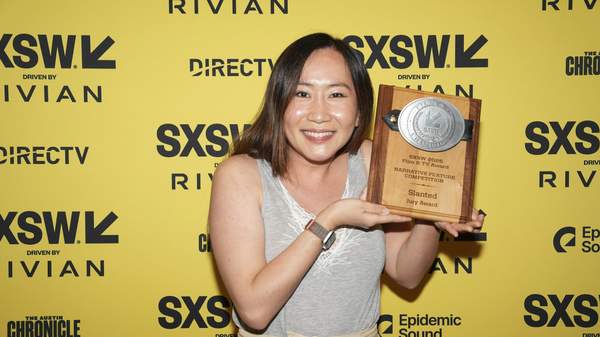
Amy E. Price/SXSW Conference & Festivals via Getty Images
On How the 12 Months Since Making Slanted Have Panned Out for Wang
"Oh my gosh, it's been nuts. It is kind of crazy to think — like even today on my phone, you know how your iPhone sometimes gives you memories of the last couple of months? I hadn't even started shooting this time last year. So we shot June–July.
I think I flew back to LA — because we shot in Atlanta — I flew back to LA in August to start post. And it's been pretty fast, when I think about it. And it was — I mean, it's still crazy. We delivered the film like three days before we premiered. I'm sure SXSW hated us with that.
So it was kind of non-stop until the premiere. The night before, I couldn't sleep because I was so nervous. And then we had such a great reaction after that first screening.
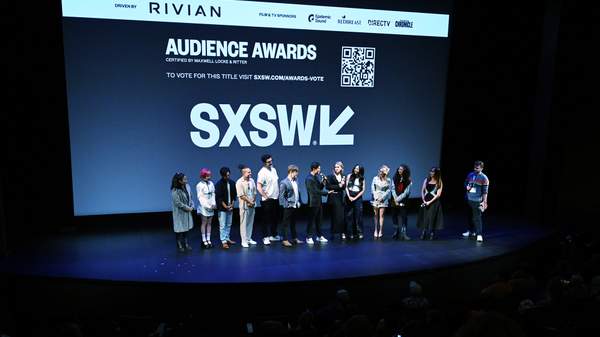
I thought the festival will tip you off if you win anything, but they don't. I wasn't even going to even go to the awards night. And I just rocked up in a t-shirt and jeans. Other people were dressed up in dresses and suits and everything, and me and my husband were just sat in the back.
It was the most-crazy experience, and so I'm still pinching myself."
On Whether Wang Expected the Type of Response That Slanted Has Been Receiving
"I think I wanted for this response, and I'm really happy that that I've received it. There was definitely a part of me that was a little bit afraid. I like to push buttons with all of my films, the scripts that I write — and in a way, I do like a bit of controversy within the stuff that I do.
So I think I was more afraid of that of — like would people take it the wrong way? Would people get offended? But surprisingly it's been — you always get the random Letterboxd reviews or even film critics critiquing the film, but the majority have been so amazing and supportive.
I remember after my premiere at South By, when I was walking to the afterparty, there were multiple people who came up to me with tears in their eyes and just telling me about how much they related to the story. And these were Americans. I'm even more excited to see the reaction in Sydney, because, again, the film came from my own experience growing up in Sydney. And Australia, Sydney in particular, has such a huge Asian population. So I'm so interested to see how people relate to the film."
Tim Levy
On How Slanted Evolved From Wang's Childhood in Australia — and Why It Embraces the US as a Setting
"The reason why I set it in America was because I moved to America in 2015 to go to film school at AFI. And I ended up staying and working in LA. And it felt, at the time when I came up with the concept, like all of my connections, my career, was really in the US. So I knew I needed to adapt the story that I had in my head to a US audience — because all the money, all of the filming crew, cast, everybody, would have been US-based. So that was really the main reason. If I had written a story that was in Australia, I wouldn't have the slightest clue how to get it made in the Australian bubble.
The story is very closely based on my own life. Growing up in Sydney, I, unfortunately for a really long time — and even now to a degree, I think we're all still working towards fully embracing and accepting who we are — but as a teenager, I definitely was very, very aware that I looked very different. And I received a lot of, I wouldn't say very violent attacks, but definitely had people throw things at me, follow me around, say very, very horrible racist, just blatantly racist things to me. And it really just made me feel ashamed of my culture, what I look like, and made me want to look like the blonde surfie girls who I went to high school with, who were the always the most popular.
And I remembered wanting to — I didn't grow up very wealthy, I would nag my mum to get me Billabong boardies and those types of bags to fit in a little bit more. And I'd get so ashamed over the lunches my dad would make me, because the kids would tease me about how badly they smelled and how weird they looked.
I'm happy that I went through it, because it's made me who I am. And I'm just really happy that I was able to make a film that I think connects to a lot of people who have experienced very similar things — even if you're not Asian Australian. I think everybody feels in some way as an outsider."
Gilbert Flores/SXSW Conference & Festivals via Getty Images
On Whether Having an Outsider Perspective in the US Assisted When Satirising the Prom and American High Schools
"Yes, absolutely. You definitely hit the nail on the head. I feel like I was able to really satirise America because I'm not American. And growing up in Australia, growing up on American films and American TV, I think I had that separation and I was able to make fun of it.
And also, I think what is cool is because I've been living here so long, to also firsthand experience the ins and outs and the intricacies of American society. I didn't, when I was in Australia, I never knew that American kids did the Pledge of Allegiance. And it was so shocking to me.
I remember when I was doing research and visiting high schools in California, and they would all do the Pledge of Allegiance — and I was like 'what? What is this?'. And it just felt so bizarre. But to an American, it's what they grew up with, so they wouldn't question it."
On Finding the Right Tone When You're Making a Satire with a Clear Sense of Humour, But That Comes From a Personal Place — and Is a Body-Horror Film, Coming-of-Age Movie and Family Drama as Well
"I feel like it's interesting because I didn't really think too hard about — I definitely thought about the tone a lot, but in terms of weaving all of these things together, I didn't think 'ooh, I have to have some body horror in there, I have to have some satire in there'.
I think the satire came organically because the initial concept was just 'oh, what if a Chinese girl turned herself into a white girl?' — and so that concept itself was so absurd and surreal that it just automatically steps into that satirical tone and zone.
And then, the reason why I'm a filmmaker is because of films like Fight Club and Seven — David Fincher in particular. My favourite filmmaker is Michael Haneke. And I grew up watching a lot of Cronenberg. So I love dark material. And it just makes sense — I wanted to make a film about learning to accept who you are but in a nightmarish storyline, so it just makes sense to see the repercussions of what happens when you decide to transition into something so drastic."
On the Importance of Also Digging Into Class Clashes
"That's just another theme that I'm very passionate about, because I don't come from a lot of money. And both of my parents are very working class, don't have any association with the film business.
And especially coming out to LA, not really having anything, going AFI — which is a great school, but really being surrounded by a lot of people who do come from a lot of money, or has a famous dad or whatever. Especially in the film industry, in Hollywood, I think, I'm constantly surrounded by people who are just wealthier.
And I think that's just something that I'm very aware of. Again, I'm really happy with everything I've been through because it always informs my work, but classism and race, those are definitely things that I just am very aware of — of my own differences and of society in general, the wealth disparity, especially in America."
On the Importance of Finding the Right Joan in Shirley Chen and the Right Jo in Mckenna Grace
"I found Shirley first. I watched a lot of auditions. And I'd always known of Shirley, cause I've seen her in Dìdi, I'd seen her in this great short called Krista, I think that also played the South By. And then she did Beast Beast, which is a great film as well. She just had such a naturalistic, kind of edgy vibe about her that I just loved. And I remember watching her initial audition just being like 'fantastic, I've found my person'. And then we had lunch and got to know her a little bit.
So I knew I had to find Joan first. And then from Shirley, getting to know Shirley a little bit more, I figured out 'okay, this is her general vibe, this is her energy', and I needed to find someone who could match that. And I met with Mckenna — and same with Shirley, I'd seen Mckenna in obviously Ghostbusters, but I saw her in A Friend of the Family, The Handmaid's Tale. She's just an incredible young actress.
We also had lunch, and she just told me how much she related to the script — and really blew me away with her interpretation. And after that meeting, I was like 'yeah, she's the one'.
After I cast the two of them, we did a lot of rehearsals and body-language imitating exercises and things like that, to really make sure they feel like the same person."
On How Chen and Grace Worked Together to Play the Same Character — and Take That Figure on a Shared Emotional Journey
"They did so much homework. I know they had shared playlists and really used music to tie themselves, the both of them, together.
But I did a lot of exercises. I had Mckenna follow Shirley around, copy how Shirley ate, how she walked, how she danced — all sorts of little fun exercises I came up with. And we also figured out one thing in the movie, that both of them will squeeze their nose, and that was something that really tied it together. And that's something I used to do and my dad used to do.
So I think that was a really easy tic that they both really caught onto. And sometimes even on set, I would forget and then they would add it into the scene, and I'd be like 'oh, this is amazing'. So they just they did the work. And Shirley would be on set when Mckenna would be on set, and vice versa, because we'd obviously shoot their scenes intersectionally, so that really helped as well."
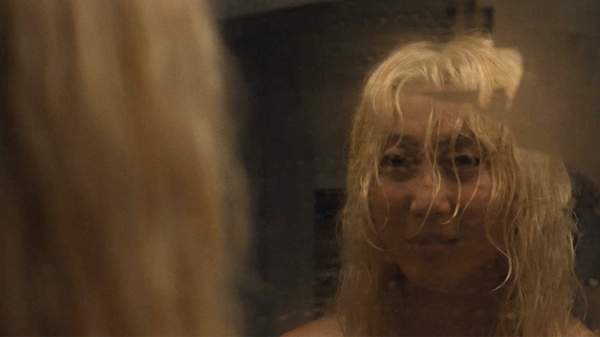
On Mixing Naturalism and Surrealism in the Film's Stylistic Approach
"So my DP and I — my wonderful DP Ed Wu [Mother of the Bride] — we had this almost like a map that's one to ten. One was the most grounded, realistic types of films, like Fish Tank, Andrea Arnold types of films. And then on the other end of the spectrum were the Sorry to Bother You kind of way-more out-there-visually satire.
And so with each scene, we'd be like 'okay, this scene, it's sitting more in the one to two', which is more the Andrea Arnold kind camp. But then some scenes, like when we're in Ethnos, definitely ventured more into that hyper-real, Being John Malkovich kind of world.
So we had that communication during set, in pre-production as well. And sometimes it was hard, because there would be some scenes where it would go back and forth a little bit. The first half might be more of a one, but then the second half is a ten. So those were a little bit more difficult to really nail.
But I think the music was also really big thing. Shirley Song [XO Kitty], she's a fantastic composer."
On How Short Films, From Scratch, The Brothers Sun and Writing on Crazy Rich Asians 2 Helped Lead Wang to Her Feature Debut
"I was never much of a writer when I got into AFI, to be totally honest. I had always wanted to direct and I went to the American Film Institute for directing. And it was my second year when I really started getting into writing, because a graduate came back and was like 'if you don't want work at Starbucks after you graduate, you're just not going to get paid to direct anything for a very long time, so you need to learn how to write'. So that advice really stuck with me. And that's kind of what I did.
So I think that on the writing side, just writing for a lot of studio films — I sold scripts to Paramount and Netflix and all sorts of places. It definitely helped me craft the screenplay in the best way.
And then for directing, I think it was just I really enjoyed my experience at AFI. It taught me a lot about directing. And you're just really drawing from personal experiences, and you take apart films. And I made a lot of short films back in Sydney. And all of that experience I think really contributed to making this feature."
Slanted is screening at Sydney Film Festival until Sunday, June 15, 2025. Head to the fest's website for more details.