Overview
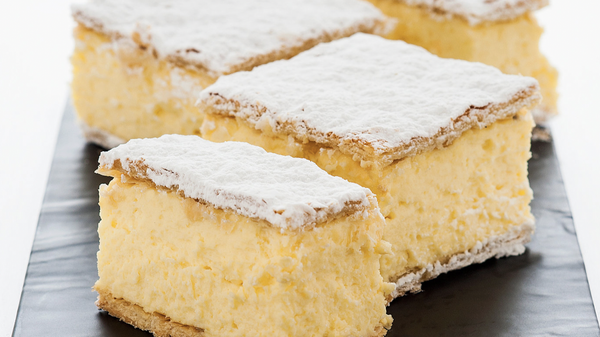
Snot blocks, phlegm cake, pus pie – whatever unsavoury name you call it, the vanilla slice and its loyal followers in Australia are entirely unfazed by the sour nicknames. Regardless of moniker, it's easy to spot in any neighbourhood bakery: a neat brick of wobbly yellow custard sandwiched between pastry and finished with a slick of white icing or a dusting of powdered sugar, depending on the region.
I'd never heard of a vanilla slice before moving to Melbourne a decade ago. It was a foreign concept when I first spotted one at La Panela – a Preston bakery best known for its vegan spins on Vietnamese and Australian classics. At the time, I didn't think much of it, instead being drawn to rows of caramel slices, faux-pink strawberry doughnuts and jam tarts. But as many of these old-school Aussie baked sweets die out, the vanilla slice remains.
Across Victoria – and increasingly, the rest of the country — bakeries loudly claim to make the best vanilla slice in Australia. The declarations appear on window decals and chalkboards, sometimes within blocks of other claimants, and often without explanation of whether the title was awarded or simply claimed.
While it's not entirely clear how the vanilla slice became so entrenched, according to the bakers themselves, European influence almost certainly played a role.
"I'm not sure why [the vanilla slice] is so appealing to Australians," says Jason Spencer, owner of Banana Boogie Bakery in Adelaide. "It's a bastardised version of the French mille-feuille. We've taken a layer of pastry out and given it our own spin."
The Dutch tompouce is another close relative — nearly identical, save for its pink icing, a variation still spotted in some Australian bakeries. There's also the Austro-Hungarian cremeschnitte and Polish napoleonka, but I suspect Australia's strong Greek influence played a bigger role; the vanilla slice bears more than a passing resemblance to galaktoboureko.
Whatever the reason, it's a dessert Australians hold in high regard, whether driven by regional pride or nostalgia.
Hudson Brown manages The French Lettuce in Carlton, home to "Melbourne's most loved vanilla slice — voted best in town", at least according to the website. It's backed by media praise and customer loyalty — something Brown attributes to consistency and familiarity. When gauging a solid vanilla slice, "you want to be transported back to a memory of something special from childhood," he says.
Brown's parents took over the shop in 2003, though it's been operating since 1984 with the same recipe. But staying traditional isn't cheap. Ten years ago, Brown says cream cost $14 for five litres. Today, he pays $20 for three. "Some bakeries use what's called imitation cream," he says. "It's basically a powder you add water to."
French Lettuce won't do that. Maintaining the original recipe is a decision Brown credits for the bakery's longevity and cult following, even as costs rise. Cutting corners, he says, is obvious to customers who care.
And boy, do Australians care. The Facebook group The Best Vanilla Slices in Australia has more than 125,000 members, with posts ranging from forensic cross-sections of custard to heated debates over pastry quality and accusations of bakeries "cheating" with packet mixes. Nowhere is this fervour more apparent than in Victoria, where the vanilla slice has achieved near-mythic status.
Victorian bakeries routinely dominate the rankings in the competitive landscape of the vanilla slice. The state even hosts an annual competition, The Great Australian Vanilla Slice Triumph, devoted entirely to the treat.
The event began in 1998, sparked by then-premier Jeff Kennett. Legend has it that Kennett ate a particularly good vanilla slice while passing through Ouyen in northwest Victoria and decided the small town deserved national attention. A Grand Prix was floated. A vanilla slice competition won out. The event ran there for more than a decade before relocating to Merbein, Mildura, and eventually back to Merbein.
Last year's top honour went to Sharps' Bakery in Birchip, a small regional shop that has become something of a pilgrimage site after a prodigious six wins at the event. "People will travel from Melbourne or anywhere to go and get their vanilla slice," says judging coordinator Anne Nash.
Beyond professional bakers, the competition includes categories for home cooks, schoolchildren and seniors, alongside awards for both classic and innovative slices. The competition is no joke – some interstate participants even set up makeshift kitchens in nearby caravan parks to ensure slices are as fresh as possible on judging day. Judges take their role seriously, too, with strict criteria around what makes a good slice.
"We're not looking for a creamy vanilla slice – we're looking for a vanilla slice," says Nash. "You have to be able to taste the vanilla." As for what differentiates one slice from another? "They don't like to share their secrets. It's very competitive."
Spencer, whose bakery placed second in last year's competition and first in 2024, edging out Victorian competitors as an Adelaide upstart, argues that the difference between a good and bad vanilla slice is immediately apparent. "You get ones that are rubbery, gelatinous, chewy – not appealing at all," he says. "Then there's the home version people make with SAO biscuits, custard in the middle and fudge icing or fondant with chocolate feathering."
He says there are a few telltale signs to look for, starting with the icing. "You can always tell if a bakery sells its vanilla slices over multiple days by the icing," he says. "Fudge icing will last two to three days in the fridge. Fondant starts running after a day. It looks terrible." Second is colour. A deeply yellow custard, Spencer says, often signals cost-cutting. A base made with water and starch keeps that hue, while custard heavy in milk and cream – like Banana Boogie's – sets much paler.
When it comes to the "best" slice, tradition still reigns, but innovation is gaining ground. Woodend institution Bourkies Bakehouse has made its vanilla slice the same way for 35 years, earning awards and fierce loyalty. At the same time, it has embraced contemporary flavours inspired by Filipino desserts. Its bold purple ube slice leans into the earthy sweetness of purple yam, while a pandan version highlights the herb's grassy, floral notes.
"With competitions now, it's all about innovation," says retail operations manager Tess Nic. "You still have your classic custard slice, but there are constant improvements and new flavours coming through."
Customers seem receptive, and other bakeries are following suit. Dulce Bakehouse, known for traditional South American pastries, has found its biggest hit in a vanilla slice layered with dulce de leche – a subtle twist that honours tradition without alienating purists.
Which may explain the vanilla slice's endurance. It's a flexible format that allows for variation, yet minimal enough that quality – or lack thereof – is immediately apparent. Despite all the claims of the best vanilla slice, it's clear that for most Australians, the verdict is deeply personal.
Like what you see? Subscribe to the Concrete Playground newsletter to get stories just like these straight to your inbox.