Overview
UPDATE: Artemis II has launched and is on trajectory as planned. Visit the NASA website for further updates.
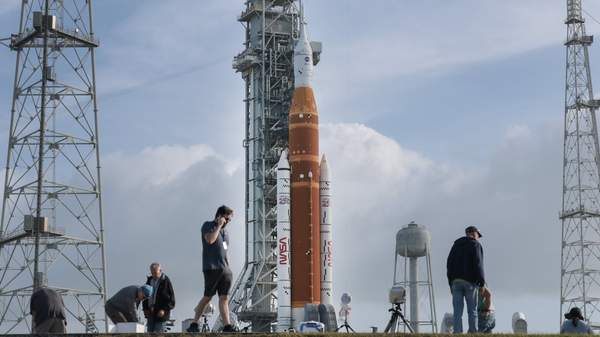
Few cultural moments are as ingrained in our collective memory as the handful of missions that have sent astronaut crews into space or celebrities into orbit. Thankfully, this time it's the former — more specifically, Artemis II, the first crewed mission being sent to the moon since Apollo 17 in 1972. In a world and newscycle that are constantly circulating bad news, this seems like an occasion worth celebrating, but nobody seems to be talking about it. So, here's everything you need to know about Artemis II.
Important disclaimer: this isn't going to be a moon landing. But, it's still an exciting mission and the first time that human beings are entering the moon's celestial neighbourhood since the Apollo missions. Artemis II is scheduled for a promising two-hour launch window that starts at 9.30am AEST tomorrow, Thursday, April 2, from where its crew of four (Reid Wiseman, Victor Glover, Christina Koch and Jeremy Hansen) will set out on the most exciting surveying job in decades.


Chip Somodevilla
Artemis II is performing a 10-day flyby mission, circumnavigating the celestial body to survey it for potential landing sites for subsequent Artemis missions, where NASA aims to have humans return to the lunar surface by 2028. The crew will collect data from orbit of the lunar surface and the effects of deep space travel on the human body — all to inform missions to come and a culminating long-term goal of sending humans to Mars in the 2030s.
It's a mission of multiple firsts, too. The crew includes the first woman (Koch), the first person of colour (Glover), the oldest person (Wiseman) and the first non US National (Hansen) to either leave low Earth orbit or travel around the moon. It's also expected to break speed records for crewed missions on its lunar transit and reentry over the Pacific Ocean.

NASA astronauts Reid Wiseman, Artemis II commander, left, Victor Glover, Artemis II pilot, Christina Koch, Artemis II mission specialist, and CSA (Canadian Space Agency) astronaut Jeremy Hansen, Artemis II mission specialist, right, stop for a group photograph as they visit NASA's Artemis II SLS (Space Launch System) rocket and Orion spacecraft. Photo Credit: (NASA/Bill Ingalls)
The American-organised mission will be supported from Australia, too. NASA's Deep Space Communication Complex at Tidbinbilla and the Australian National University's (ANU) Quantum Optical Ground Station at Mt Stromlo Observatory will provide tracking and communications support for the mission.
Australian astronaut Katherine Bennell-Pegg told the ABC,"In the Apollo era, Australia hosted the most amount of tracking stations outside of the US that supported Apollo. We were absolutely critical then; we are also absolutely critical now."

Joe Raedle
But why is nobody talking about it? A lot of hype was built for the mission's original launch in February, only for it to be postponed by hydrogen leaks, so perhaps the rescheduled date has already been swallowed by the ruthless news cycle and the stories surrounding the fuel crisis, Iran War and any other myriad of upsetting current affairs. Plenty of people are talking about space via Project Hail Mary, but this is the real deal.
But now you know. Tomorrow morning, you can tune in to the live broadcast of the launch window on NASA's YouTube channel. It currently has an 80% chance of being a successful launch, pending the weather holds. Should it be a success — humanity will be taking its biggest step towards a future in the stars since Apollo 11 landed all those decades ago.

Like what you see? Subscribe to the Concrete Playground newsletter to get stories just like these straight to your inbox.