Overview
Innovators have been prepping us for hospitality automation for a long time. The first recorded instance of robot waiters dates back to 1983, when a Chinese restaurant in California introduced two anthropomorphic machines to serve diners. Vending machines were popularised from the late 1800s, and The Jetsons primed generations for a future where robots took care of domestic duties.
We've seen that future come into focus in the last few years, as soda fountains and drive-thrus have made way for sushi trains, QR code ordering systems and even more robot waiters, both on the floor and behind the bar or pass. Some may remember the short-lived Niska pop-up at Melbourne's Fed Square, where bow-tie-wearing robots took orders and scooped ice cream. About as efficient as your average scoop shop, the automation was gimmick above all else, much like the deep-frying robot that cooks chicken in the window of SamSam Chicken & Beer.


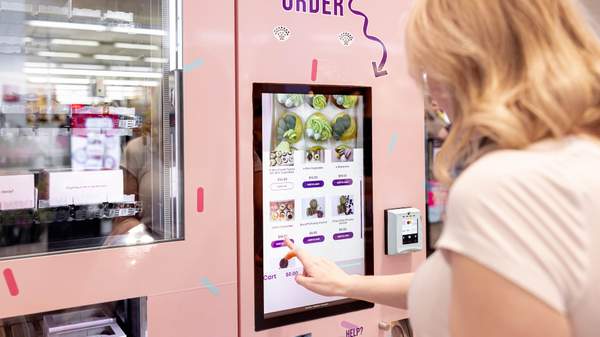
But these novelties offer a gateway to other forms of food automation. The uptick in uncanny, AI-generated restaurant imagery has, for better or worse, further opened diners' minds to the possibility that machines might have a role in the way we eat. Food delivery robots, already taking off in the United States, Asia and Europe, are being trialled around Australia. Then there are formats like The Heinz x Nico's Deli Night Shift, where diners can order sandwiches from a self-service automat.
But some of the most consequential automation is happening out of plain sight.
It's most evident in coffee. American chain Blank Street Coffee was an early adopter, introducing Swiss-made Eversys espresso machines to streamline operations, reduce staffing requirements and accelerate production across its cafes. Melbourne cafes like Atelier Enso and Analog have since caught on, supplementing standard equipment with Eversys and XBloom filter coffee machines – automated pour-over systems that grind, scale and brew in one. Flying Turtle, a Thai-developed automated beverage machine serving coffee, tea and soft drinks, now has outposts around Melbourne.
Then there's Jin Noodle, a Northern Chinese noodle shop with a range of machines for different purposes: one folds dough, another shapes noodles, and another slices them directly into a pot of boiling water.
It may seem ironic for knife-cut noodles – a centuries-old craft traditionally dependent on a deft hand — to be handed over to robots. But owner Andy Li says post-COVID hygiene concerns have set a new precedent — in China, where he's originally from, and increasingly in Australia.
Humans make mistakes. Humans forget to wash their hands. Humans get sick. Machines don't. Therefore, for some operators, they're superior.
This isn't an entirely new idea. In the early 20th century, growing anxieties around food purity and contamination helped turn factory-made food into a selling point, particularly in the United States. Take, for instance, the rise of mass-produced sliced white bread, which was marketed as a purer, cleaner alternative to homemade bread. Upton Sinclair's The Jungle, which exposed the horrific conditions of America's meatpacking industry in 1906, helped intensify broader public concern about the safety of the food supply and contributed to food-safety reform. Now, more than a century later, it seems the pendulum may be swinging that way again.
Contactless payment is preferable to handling cash. Self-service is efficient. QR ordering was once annoying; now it's barely worth mentioning.
Of course, there's the question of labour. If a machine can make 100 coffees with fewer staff, what happens to the person who would have made those coffees? If a machine can slice noodles, roll dough or perform another repetitive kitchen task, why pay someone to do it?
But automation doesn't necessarily mean removing humans from the equation altogether. Atelier Enso owner Alicia Feng says the opposite: automation frees her up to focus on other parts of the job, like chatting with customers for more than a few minutes between pouring shots and frothing milk.
Meanwhile, at Jin Noodle, cooks are still preparing the sauces, which rely more on human intuition when seasoning bases and browning meats. The machines simply streamline the noodle-making process and staffing requirements, making the business more sustainable.
Automation is often considered the enemy of hospitality, and in some ways it is, because it threatens to remove the humans who make it hospitable. But if removing humans from the repetitive parts of the job gives them more time to actually be hospitable — and means the business can exist more profitably — perhaps the decision to automate (or not) isn't so black and white.

Images: Supplied.
Like what you see? Subscribe to the Concrete Playground newsletter to get stories just like these straight to your inbox.