Overview
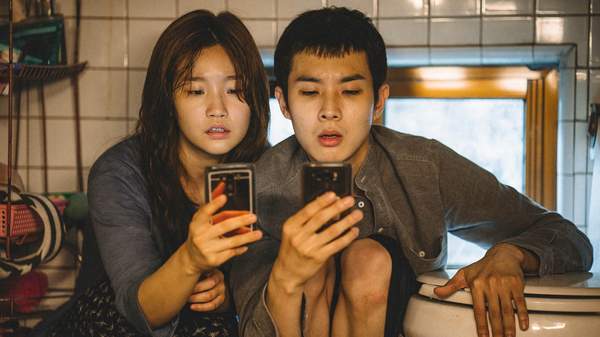
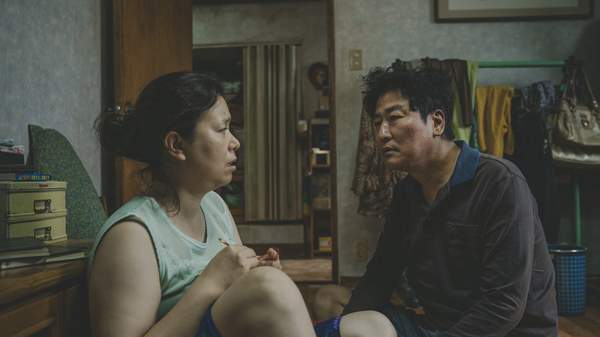
Before Parasite and after Parasite: for audiences, for the film world in general and for composer Jung Jae-il, that then-and-now split applies. Bong Joon-ho's 2019 movie earned immensely deserved devotion and collected almost every accolade that it could — including the Palme d'Or at Cannes, the Sydney Film Prize, a Golden Globe, two BAFTAs, a Screen Actors Guild Award, an Asian Pacific Screen Award, five Grand Bell Awards and, making history, four Oscars — as it wowed everyone, viewers and awards voters alike, with its class-clash black comedy/thriller tale. It wasn't Jung's first collaboration with the Memories of Murder, The Host and Snowpiercer director or his last; however, it was an unsurprisingly pivotal, influential and impactful experience.
"First of all, I just fell in love with film music," Jung tells Concrete Playground. "Because I'd been composing for so many genres, like dance, pop, all genres, for decades, but I'd never thought I would be a professional film composer," he continues. Prior to Parasite, Jung had other film scores to his name, including for the Bong co-written and produced Haemoo (also known as Sea Fog) and the Bong-directed Okja, but lending his musical talents to the Kim family's efforts to infiltrate the Park household "was very challenging and exciting," he notes. "And making music for the film, it just made me go deep inside of me. Trying to translate the director's vision and the edit, the cuts, I have to understand what the cut needs in a musical way."


"I felt like I have to be a translator‚ to translate the director's vision to musical language. And it was very exciting — sometimes very despairing — but [I thought] 'oh, this could be my turning point'," Jung furthers. "And as a pop musician, pop composer, pop music is very short. Sometimes it's even two minutes. And I had a really hard time to make that short music, because I like to make drama in music — but to make drama, it's too short," he says. "So all of this is very inspiring. I can give my mind more to film music. I just love that."
Jung's music career dates back to being a teenager. For the big screen, he's now also the composer behind Bong's Mickey 17, Hirokazu Kore-eda's Broker — the acclaimed Japanese filmmaker and Shoplifters Palme d'Or-winner's first South Korean feature — and 2025 Sundance-premiering American dramedy Twinless. On the small screen, one of the biggest streaming sensations of the 2020s wouldn't have proven the same without his integral contribution, with scoring Squid Game also on Jung's resume.
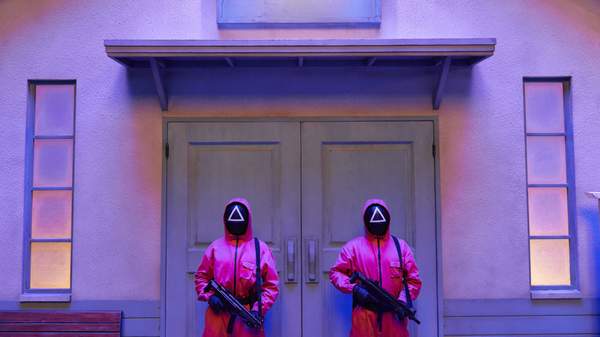
Squid Game S3. No Ju-han/Netflix © 2025
Thanks to that fight-to-the-death hit Netflix dystopian thriller dropping its second season at the end of 2024, then its third and final run in mid-2025, and also due to Mickey 17 reaching cinemas and Twinless doing the film festival rounds as well, the past year has been particularly huge for Jung. Now comes a trip to Australia for something that's rarely occurred before: Parasite in Concert. At the Melbourne International Film Festival — where Twinless is also playing — the composer is both performing and conducting Parasite's score live, aided by Orchestra Victoria, across two shows on one day.
"It's very special for any composer, because it's a live-to-picture show. Just performing scores live is very common, but with the screen from top to the bottom it's so very rare. It is quite challenging as well — but for me, it's a lifetime experience as well," Jung advises. The complexity springs "because I should play exactly with the screen. So we have a very complicated playing system, the metronome and clicks, and all that. That is very challenging."
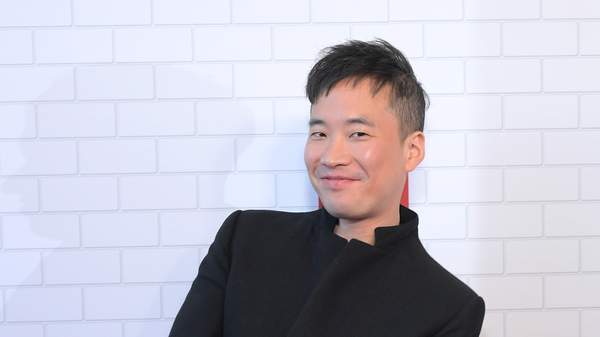
Charley Gallay/Getty Images for Netflix
What goes into preparing for Parasite in Concert for Jung? "It's very simple to play just by myself, but I have to collaborate with the orchestra, so I should prepare the score and parts, and talk with the maestro or the musical director," he explains. "And I'm going to move to Melbourne just before, three days or two days before the show, and rehearse with them for about a whole day. So I should prepare the two-hour score in a day. That's very challenging for me, but very exciting as well."
Attendees will witness the results on Saturday, August 23, 2025 at Melbourne's Hamer Hall, in what's set to be one of the highlights of MIFF's 73rd edition — and a stunning way to help close out the festival's Thursday, August 7–Saturday, August 24 in-person stint for the year (its online program also runs from Friday, August 15–Sunday, August 31). Jung is also set to speak about his career on the same morning in an hour-long in-conversation session. In the lead up to his trip Down Under, we chatted with him about his composing journey so far, too, as well as working with Bong Joon-ho multiple times, finding inspiration, his path to Squid Game, his first response to the show's premise and more.

On Jung's Journey as a Composer Leading Up to Parasite
"When I was a teenager, I worked as a session musician — guitar and piano. And for many composers and many singers. And one day, this one composer called Won Il— he is a very famous composer, especially in traditional and film composing in Korea — suggested me to arrange some parts of a score, and that was the very first start for me.
And then as a main composer, I worked for a film called Marine Boy. That was my first film. Nobody knows the film in Korea, but it was a little bit not a good experience for me — too many works and too little income. So I thought 'I cannot be a film composer right now'.
So I just forgot about that. And after that, Baram just came to me to work with them, and they required me to make music with only traditional Korean instruments. That was very challenging and very interesting, so that's why I said 'okay' for them. And with that film, it was very interesting, but not helpful for my life — not helpful for my financial situation. So I just forgot that.

And after that came the film Sea Fog, which is the film where the executive producer was Bong Joon-ho. And with the film, 'oh, this is film scoring. Oh, this is quite exciting.'
And I love the orchestra — and I could use the orchestra a lot. So that was a very satisfying project. Sea Fog, nobody knows as well, but I just started to see the precious thing in film scoring.
And with Okja, Parasite, I just definitely fell in love with film scoring."
On Jung's Creative Partnership with Bong Joon-ho Across Okja, Parasite and Mickey 17
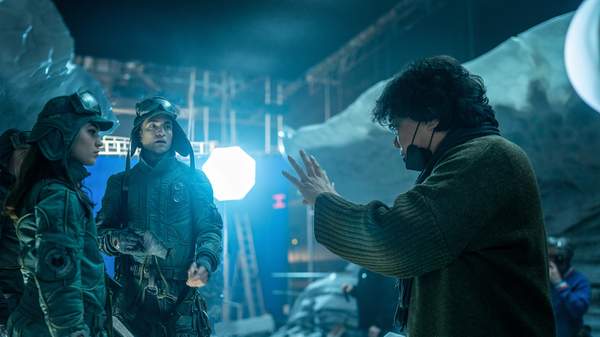
"As I said before, I'm just a translator. I don't want to express my own individual musical taste or musical hope like that. I'm concentrating on what this director is thinking and what this cut is saying to me.
That's why Mr Bong Joon-ho likes me, because I'm just concentrating on his vision only. But that's the basic attitude for me to work with other directors as well."
On the Bong Joon-ho's Meticulousness and Precision — Including Only Shooting the Exact Shots He Needs, and How That Type of Approach Carries Over to Movie Scores
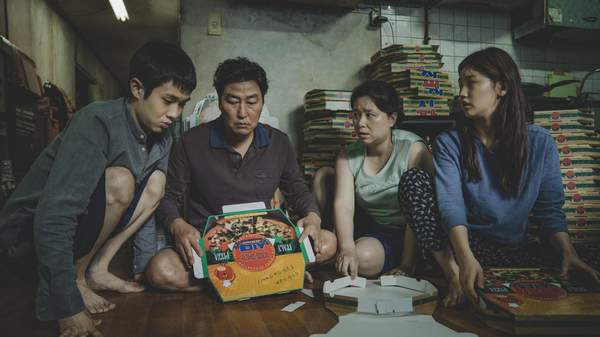
"To be honest, that is very common in Korean film. Everybody does that. But Bong Joon-ho really explains precisely what he's thinking. So, I don't say that much. He just tells me what he's been thinking and how this cut is completed — I think that's it.
And when you get the final locked version of cut, after that I have to take care of everything regarding music. But when he doesn't like my first version of music, he tells me what he doesn't like, what he likes, very precisely — sometimes in a very imaginative way, sometimes in a very practical way.
That's why Mr Bong Joon-ho is different among other directors."
On Finding Inspiration for a Score From Beyond a Director's Instructions
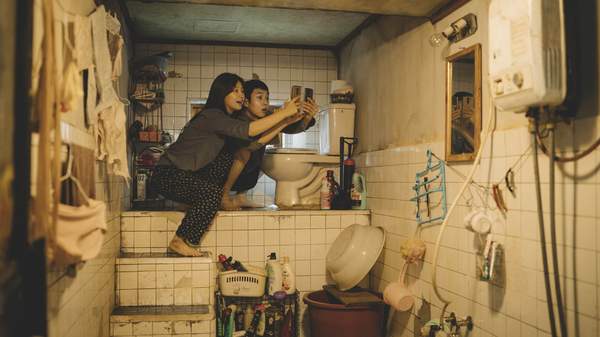
"For Parasite, Bong Joon-ho just told me that he'd been listening to baroque music, baroque-era music, a lot while he was writing the script.
But as a self-taught composer, I didn't know much about baroque music. So I had to research Vivaldi, Bach every day. Sometimes I played Bach's 'Goldberg Variations' every morning.
So I practiced and I exercised to get the baroque elements into my body, into my heart. That's one way to find the inspiration."

On Getting Into the Right Mindset for Parasite
"As a film composer, the first opening theme is very important. Even though it's not a main theme, the opening theme is very important for a composer because it's the first step.
And with that first step, the path is going through — and in the script of Parasite, the first phrase was 'very hopeful music with despair'. I didn't know what to do, so I tried several versions of opening them."
On How Genre Impacts the Way That Jung Tackles a Film Score
"Basically I love drama, because I love to use the orchestra or piano, rather than computer music or band music. So I prefer drama rather than sci-fi or a thriller.
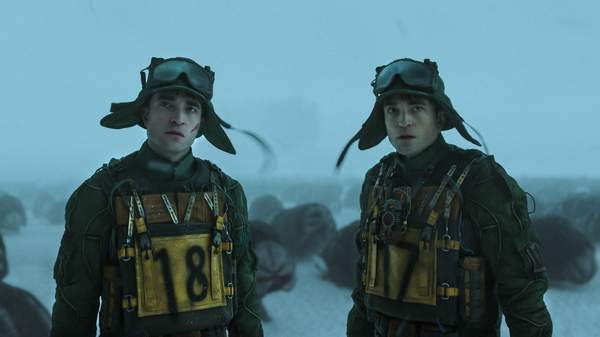
For Mickey 17, it's a sci-fi, but it's a film about love at the same time — love and hope and peace. So I could use piano and orchestra in a very traditional way, because even if it's sci-fi, I could make the score in a very traditional way — and I am very happy with that."

On Working with Hirokazu Kore-eda on Broker
"I just watched this film Nobody Knows in 2004. I was really shocked, and I just fell in love with this film. And I've been tracking all of his masterpieces for decades.
And finally, I heard the news that he is going to make a film with Korean staff and Korean actors. So I just wrote a letter to him with my previous works: 'I would love to work with you in Korea'. That's how I worked with him.
That was the first time I approached a director before he approached me."
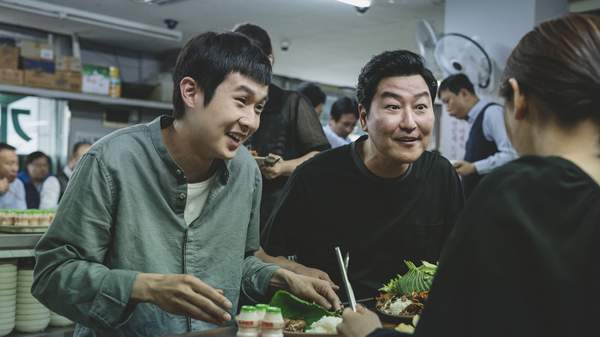
On How Parasite's Success Helped Jung's Career, Including Putting Him on the Path to Squid Game
"It was unbelievable recognition for me. I'm just a person who works backstage, behind the curtain. I had many opportunities, many chances.
And because of Parasite, I just met director Hwang Dong-hyuk of Squid Game. And Squid Game is an unbelievable success. It's a phenomenon.

I got proposals from many American directors for many scripts — and even I released my own solo album with Decca Records in London, which I'd never thought about before.
But for me, my life is not that changed, because I'm just working alone in my own studio. But the obvious thing is now I don't have to prove myself to other people. That's quite comfortable for me — I only need to concentrate on how to make good music. That's the most-important part, most-important change for me.
And I just fell in love with series or film music — to translate the vision into musical language. That's very powerful work and very useful work at the same time, because film is not going to fade away — music is film's best friend.
So they're the most-exciting changes for me."
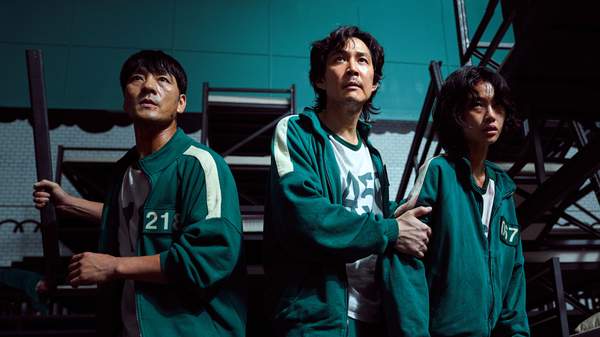
On Jung's First Response to Squid Game's Premise
"It was so brutal and cruel, so I just thought 'I could do this' and 'this is very quite exciting'. And I was a fan of Mr Hwang Dong-hyuk because of his previous work called The Fortress. I've watched that film about 10–20 times.
So I had very deep faith in him. So even though the script was very brutal, full of blood, I could read the humanity. The very deep studying of humanity — I could read that in the script, even in the tragedy and violence.
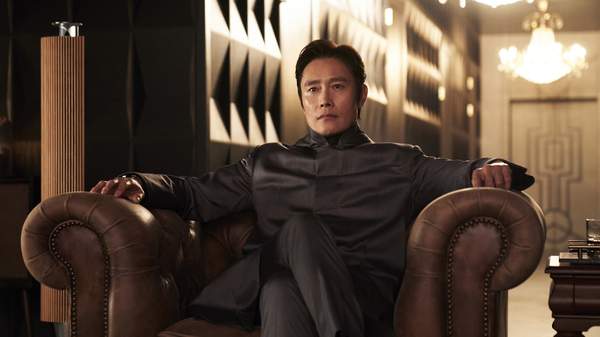
Squid Game S2. No Ju-han/Netflix © 2024
So 'yeah, why not?'. Because he was my hero, one of my heroes — and 'yeah, I would love to do this'.
But for me, it was very challenging as well because it was a series — my first time on a series — because I was very used to two-hour films. But this is nine-hour films. So 'oh, I could do that?'. That was very challenging for me."
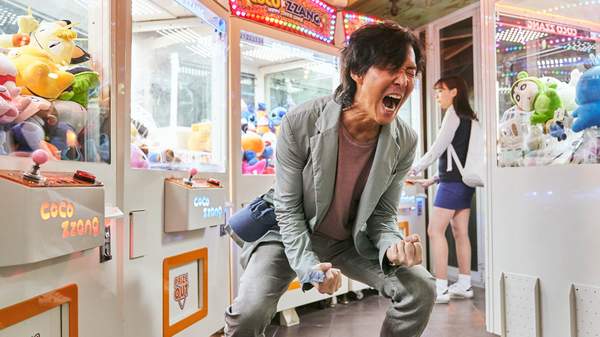
Squid Game S1
On the Influences for Squid Game's Score
"Every time that I make a new score, I search for a unique way. Unique is better than common things. That's how I'm thinking.
So I just found these musical instruments which are very familiar for Korean children in elementary school — they learn that instruments like recorder, castanets, tambourine, melodeon, that kind of thing. And 'oh, that that could be very interesting'.
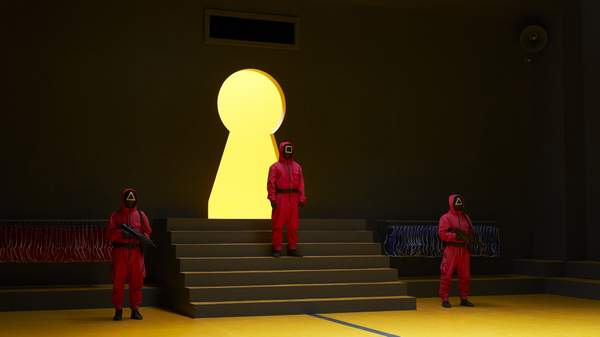
Squid Game S3. No Ju-han/Netflix © 2025
And children are not good at performing, so they make disharmonies and no rhythms, then that makes some kind of scary sounds as well. So 'let's start with these elements'. That was my first way to approach Squid Game.
And I composed some cues that felt a little bit like Hollywood-style music, but Mr Hwang Dong-hyuk really hated that Hollywood-style approach. So I just thought 'alright, I could just remove this Hollywood-style, I'm going to stick to very unique and powerful, sometimes-traditional style'. That's how it started from the first part."

On Evolving the Music for Squid Game Across Three Seasons
"I think I just concentrated on how to make this scene powerful. I could revise or rearrange and repeat the main theme — the successful themes — time to time, but I decided to make original ones a little bit more.
So one is very different from two. Two is very different from one. And three is very different from two. But for season three, I repeated this one theme called 'I Remember My Name', which is first used in season one and it represents the farewell in death. That is the most-repeated theme of Squid Game — and other than that, all are original."
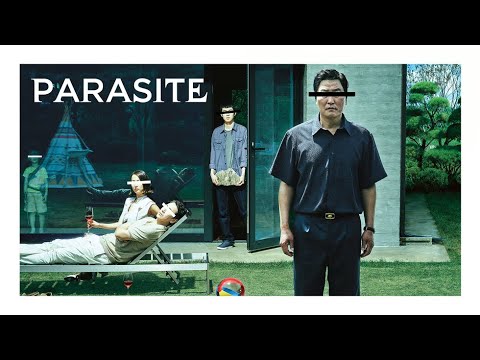
Parasite Live in Concert takes place on Saturday, August 23, 2025 at Hamer Hall, Arts Centre Melbourne, 100 St Kilda Road, Southbank — head to the venue website for tickets and further information.
The 2025 Melbourne International Film Festival runs from Thursday, August 7–Sunday, August 24 at a variety of venues around Melbourne; from Friday, August 15–Sunday, August 17 and Friday, August 22–Sunday, August 24 in regional Victoria; and online nationwide from Friday, August 15–Sunday, August 31. For further details, visit the MIFF website.