Overview
King Island can feel, at first, like a place slightly out of step with the rest of Australia. Not in a quaint or nostalgic way, but in the sense that many of the habits metropolitan life takes for granted — endless choice, constant access, imported convenience — simply never became the island's organising principles. Freight is expensive, margins are slim and distance has a way of clarifying what is worth the effort. As a result, much of what you eat and drink here is grown, made or caught close by, and much of the best of it stays close to home.
That logic runs through almost every part of a stay on King Island. Sustainable practices do not announce themselves with much fanfare, because they were never designed as branding exercises. They emerged because waste is expensive, because byproducts need a second life, because making do has always required a degree of imagination. Spend a little time here and you begin to sense a version of localism that feels older and less performative than the one sold back to us elsewhere — a place where resourcefulness still reads as ... common sense.


City of Melbourne Bay, King Island — Andrew Wilson
The landscape deepens that feeling. King Island has a kind of elemental intensity that seems to pull everything back to first principles: wind, salt, rain, pasture, rock, sea. The colours and textures can feel almost pre-human in their arrangement, as though the island has been only lightly negotiated with rather than fully tamed. There are pillow-soft moss beds, natural springs and enormous swells that hit the shoreline with such force they seem to erase any illusion of control. Even the gentler-looking parts of the island carry some trace of that exposure.
Which is why a weekend here works best when it is not over-programmed. King Island rewards people willing to plan enough that the practicalities fall away, then leave space for weather, appetite and mood to take over. This is a place for reading by a picture window while the ocean lashes itself into a frenzy outside; for structuring a day around cheese, beef or crayfish because that happens to be what the island does especially well; for walking into the wind until you understand, physically, what sort of coastline you are dealing with. A trip here is rarely about ticking things off. It is about bearing witness.
Kittawa Lodge — Emilie Ristevski
STAY
Kittawa Lodge
If there is one stay that best distils King Island's particular mix of wildness and care, it is Kittawa Lodge. Set on a remote stretch of coastline in Pearshape, the off-grid retreat sits lightly within old sand dunes and open ocean country, giving you the sense of being deeply embedded in the landscape without ever having to rough it. The architecture keeps the outdoors visually close at all times — glass, timber, sky, weather — so that even from inside, you remain in active conversation with the island.
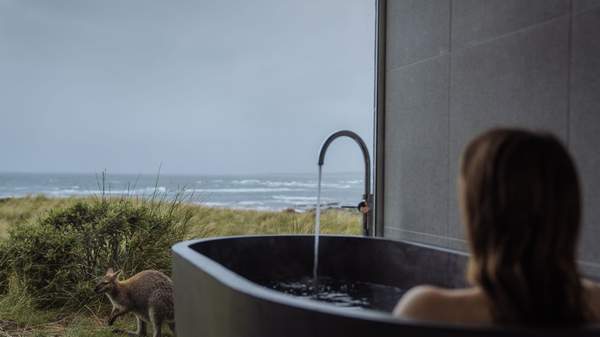
What Kittawa understands especially well is that luxury on King Island works best when it feels inseparable from place. The hospitality is thoughtful without becoming fussy, the provisions and pantry draw heavily on island and Tasmanian produce, and the whole experience has been designed around privacy, immersion and a certain kind of delicious withdrawal. You can venture out, of course, and should. But there is something deeply persuasive about returning to a lodge where the bath faces big weather, the hot tub sits ready for an evening soak, and a quiet hour with a book can feel as transportive as anything you might have driven to.
Perfect for: travellers who want their stay to feel deeply tied to the landscape around them.

King Island Distillery — Jasper Da Seymour
EAT
Dining on King Island asks for a little more forethought than most Australian holidays, but that extra effort is precisely what makes it memorable. This is an island where convenience has never really been king, and the food culture reflects that. You need to decide what sort of trip you want to have. Do you want to nest, cook and stay close to your accommodation? Or do you want someone else to take the lead while you simply turn up hungry? Either way, the reward is the same: produce of startling quality, handled with a kind of proximity that makes the whole experience feel more direct.
If you are staying at Kittawa, self-contained dining feels less like a compromise than part of the pleasure. The provisions are generous, the kitchens are beautiful to use and the lodge's own approach to catering leans into the island's strengths, which means your meals are likely to be built around exactly what you came here for in the first place. In Currie, you can also assemble your own version of the island pantry, whether that means a stop at the gourmet suppliers, a supermarket run for a quiet night in, or a slower browse for ingredients that will make staying close feel better than going out.

The Boathouse, The Restaurant With No Food — Jasper Da Seymour
Then there is The Boathouse, the island's much-loved "restaurant with no food", which may be the most King Island dining experience imaginable. There is no menu, no front-of-house choreography, just a beautiful old harbour-side building and the understanding that you will bring what you need. For something like this, Salt & Thyme makes perfect sense, catering beautifully whether you want to eat there or take something home to heat up later. The food story on King Island often works like that: part planning, part trust, part allowing the island's scale to shape your appetite.
In terms of what to build your meals around, the answer is fairly obvious. Crayfish and beef are central to the island's food identity, and both are best treated as anchors rather than occasional indulgences. The famous crayfish pie from the bakery in Currie has become a rite of passage for good reason, and one of the quickest ways to understand the island's relationship to produce: modest in presentation, very serious in flavour.
King Island Dairy belongs in the same category. The island's sea spray and salty pastures have a hand in the flavour profile of its milk, which reaches its highest expression in cheese. Structuring your meals around these things — cheese, beef, crayfish — is less a gimmick than a sensible response to place.
DO
On King Island, the most memorable things to do are really just different ways of understanding the landscape. You can taste it, you can move through it, or you can sit still long enough to let it reveal itself. However active you plan to be, the island keeps insisting on the same lesson: nature still holds the upper hand here.

King Island Dairy — Stu Gibson
Taste
A stop at King Island Dairy is, of course, about cheese, but also about climate, pasture and the slow accumulation of local skill. The island's sea spray and salty grass are part of the flavour story, and tasting the cheeses on-site gives you a more immediate sense of how thoroughly place works its way into the finished product. The Dairy is one of those rare food experiences that feels both iconic and genuinely informative, a chance to understand the island through something rich, familiar and quietly precise.
The same goes for a visit to the Brewhouse or a tour through Raff Family Farm. At the Brewhouse, the setting among grazing country keeps the island's agricultural life close at hand even while you are holding a beer. At Raff, the story of pasture-fed Angus starts with the conditions that allow grass to grow year-round — mild temperatures, steady rainfall and the maritime influence that shapes almost everything else here — long before it reaches the plate. These are all, in their own way, lessons in terroir.

Seal Rock — Jasper Da Seymour
Go
The island's maritime history is one of the clearest expressions of its power. Bass Strait offered ships a useful shortcut, but the price was often catastrophic. Reefs, poor charts, violent weather and a coastline lined with jagged rock made these waters notoriously unforgiving, and King Island, sitting at the western entrance, bore the consequences again and again. The Cataraqui wreck of 1845 remains Australia's deadliest civilian maritime disaster, with hundreds of lives lost within sight of shore, and once you stand out there yourself — in the full force of the wind, looking at the same broken water — the story takes on a physical clarity that no museum panel could replicate.
That is what makes the island's maritime trail, memorial cairns and museum in Currie so affecting. They deepen your understanding, certainly, but the coastline does the real interpretive work. Beauty and danger are so tightly bound together here that one seems to sharpen the other. Follow the stories of the Neva, the Netherby and the Cataraqui, and a pattern emerges: this is a place where the sea is not so much something to swim in, but something powerful to behold.

Ocean Dunes Golf Course — Dearna Bond
The same is true when you set out on foot. Walking on King Island feels right because the terrain remains so under-smoothed. There are tracks and boardwalks, certainly, but the island never feels overly interpreted or overly managed for the visitor. The Calcified Forest has that strange, time-warped quality that makes it feel half geological site, half fever dream, while the cliffs and sea spray around Seal Rocks make it clear that this landscape is best encountered with your body, not just your camera. Even easier walks around Currie carry something of the island's force, whether that is kelp-strewn shoreline, shifting light or the steady reminder that the weather is never simply scenery here; it is an active participant.
Golf belongs in that same conversation. Cape Wickham and Ocean Dunes may be the famous names, drawing pilgrims for rankings and bragging rights, but what makes golf on King Island memorable goes well beyond the scorecard. The courses are so exposed to the elements, and so thoroughly shaped by the coastline, that the game begins to feel like a negotiation with wind, cliff edge and open sea. The island has a way of making golf look less manicured and more elemental, as though even here, at its most polished, the landscape has reserved the final say.

Kittawa Lodge — Emilie Ristevski
Witness
King Island does not demand constant activity. In fact, part of understanding it means knowing when to stop seeking out the next thing and simply stay put. Kittawa is especially good for this, because the architecture has been designed to keep the outdoors visually close even while you remain protected from it. The baths face enormous skies and ocean through picture windows; the hot tub sits outside with the weather still palpably present; the property's placement among old dunes and private coastline means that reading a book indoors can feel strangely eventful when the sea is throwing itself around just beyond the glass.
It may not look like an activity in the traditional sense, but on King Island, bearing witness is part of the itinerary. The wind rises, the light shifts, the ocean crashes imposingly against the shore — the whole island keeps reminding you that it has always answered first to the elements, and to us second.
Concrete Playground stayed as a guest of Tourism Tasmania.
Images: Tourism Tasmania
Subscribe to the Concrete Playground newsletter to get stories like this delivered straight to your inbox.