Concrete Playground interviews Daniel Askill
This extraordinarily in-demand video maker generously sneaks outside to tell us about his work, his family and his forthcoming visions.
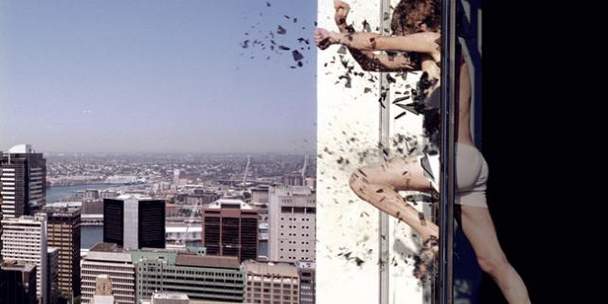
When I speak to video maker Daniel Askill, he's at the newly opened Edition on the corner of Liverpool Street. He's preparing for Slow Work On A Bright Screen, his exhibition which is due to open this evening. This extraordinarily in-demand practitioner generously sneaks outside to tell me about his work, his family and his forthcoming visions.
We begin with the book of the same title, which this exhibition will launch, as I ask Askill how the idea came about. 'I think it came about because they asked me if I was interested in doing a show in their store, at Edition. I thought it would be a bit more fun to do a little book, to have something that they could actually sell in there. There was a particular collection of work I'd been doing which was all commissioned from different people but they weren't commercially geared. There were very different people that had asked me to make films for them, just to do whatever I wanted really. So over the past few years, there'd been quite a few of those. And yeah, it seemed a nice idea to collect those and turn them into a little book.'
When I mention that a book for an artist of moving images might initially seem a little counter-intuitive, he answers honestly, 'I don't know, I guess since the type of video work I do is very image-based, based around singular, slow-moving images and stuff like that, it translates very easily into a photographic form. And a lot of the projects had photographic components anyway.'
This emphasis on imagery is surprisingly true of Askill's work. There is a constant underlying tension between movement and stillness, action and moment. In the exhibition, this book and posters of stills sit alongside screens playing extracts from Askill's videos. When I ask if this is a deliberate juxtaposition, Askill replies, 'I guess there are always naturally images that come out of the video work I do that end up being used in a context - whether it's in magazines or websites or whatever. So it just came out of the natural inclination to collect this particular group of work into one little volume.'
Askill's endeavours have been many, but perhaps one he is best known for is his music video clips. As a man who clearly has a consistent style and vision, I wonder if Askill draws his ideas from the music, or whether he comes across music that fits his ideas. Apparently, 'it's always a combination of the two.' Askill explains, 'With a music video, you always want to do something that's right for the band, and all that kind of thing. And inevitably you combine that with something you want to do yourself. It shifts as well. There's music videos that I've done that aren't included in this little book, for instance, that are very much about creating the image of the band and doing something that's about their world and for them, really. There's only one music video that's in this little book, and that's one for These New Puritans. That's kind of at the very other end of the spectrum. They were like, "Here's a track we've made, you just make whatever you want for it." It wasn't about showing the band playing their instruments or any of that sort of stuff. That was much more a collaboration between the music and the images, and being true - obviously they were true to what they'd done musically and I was being true to what I was doing visually. ... And those ones obviously are the ones that are more fun - where you're given a lot of freedom and there's a lot of mutual respect between the band and who's making the film.'
This 'truth' and integrity is something that Askill is particularly well-regarded for. I comment to him that it must be nice to be in a position where people come to him wanting specifically what he does - something which no doubt requires a large degree of trust. 'Yeah, it's nice when those projects come along,' Askill comments casually. 'That comes back to the idea of what this little collection is about, they're all those kind of projects that have been very much a collaboration with one particular person. Whether it's a fashion designer or a musician or whatever. Doing it', Askill pulls out his proper English accent, ' "for the sake of art", I guess.'
Like all of us in the real world, Askill deals not only with such ideal collaborations, but also with work that demands a great deal of judgment and compromise. When I ask Askill how his approach and process change for different clients, he answers. 'As we've been talking about with the music videos, there's stuff that sits closely to the commercial realm and there's stuff that leads into the art kind of space. At the other end of the spectrum, when you are doing a commercial, you have to give in a little bit, a little bit more pandering to their needs. But that's usually compensated by the fact that there's a much bigger budget involved and you're getting the chance to work with other great practitioners, cinematographers, going to amazing locations... Whatever it might be, there's always that kind of trade-off. Fundamentally, for me, I just make sure that I never get involved in a project where I don't think there's at least going to be some sense of integrity in what everyone's trying to achieve.'
What Askill manages to achieve often draws on particular technologies, playing with the ways in which we perceive things. I ask Askill whether he tends to begin with an image in his mind and then finds the technique to achieve that, or whether he starts with the technology and then finds a concept to fit. Again, he replies, 'It's a combination. I find if I'm doing something that's a bit more narrative, like a short film, I tend to have a very specific image in my mind and it's really about working out the best technical means to create that image. In things that are a bit more installation-y or video-art based, I find you're more searching for a feeling or an idea, and there'll be a technical approach that you know will help get you there. I find, in that sort of space where I'm looking to try and create something you can see with your own eyes, it's really about just documenting. A paper bag flying along the street or something. It's more about trying to create something that, without getting too heavy about it, tends towards something more metaphorical. And technically, the best way I can find to create that is using techniques that your eye can't do. Whether that be through slow motion or particular cameras or time-slice rigs or any of those techniques that render the world in a way that we can't see it ourselves.'
The strange and almost magical way that Askill presents the worlds of his videos implies a broad and vivid imagination. The fact that he often works with his brothers makes me wonder whether this is something that grew out of their childhood together. 'I guess it is,' Askill admits. 'I just feel really lucky with my brothers, we've always had similar interests and stuff. My dad's a musician and my mum always painted, so it was a pretty arty upbringing. It's probably only been in the last five years or so that we've really tended to work a lot together, but I guess it was always moving in that direction. And yeah, it's got to the point now where I think we all find it hard to get anything done without constantly relying on one of the brothers' opinion or input at some stage.' I comment that it must be a pretty amazing thing to have that close-knit network, especially with his parents involved also. 'I'm really lucky like that, I think,' he replies. 'Touch wood.'
My final question to Askill is - what's next? What does the future hold? 'There's lots of bits and pieces,' he explains, 'but the main thing I'm trying to concentrate on at the moment is a feature film project that I'm always hesitant to talk too much about because these things take such a long time... But I'm heading over to L.A. next week to do some writing with a writer over there to develop this feature idea I've been working on, with a hope to try and get that off the ground in the next year or two. And parallel to that, all the other sorts of stuff...' Askill details that this 'stuff' includes a premier in Stockholm and a Smirnoff commercial, involving Manchester United fans, to be completed in September. This starts my mind spinning, and I comment that I can't wait to see it all - especially the feature film. Askill laughs, and says, 'Yeah, same here. It's one of those type of projects where every time you think you've got to the next stage, a whole another hundred miles of road seems to open up...'
We can only hope that Askill will reach the end of it with his vision intact. For some reason, I have faith that he will.
Image: still from We Have Decided Not To Die


- The 25 Best Pubs in Sydney
- CP Picks: Aussie Summer Essentials — The Things We're Packing, Wearing and Using All Season Long
- CP Picks: The Editor's Gift Guide —What the CP Team Is Giving (and Hoping to Receive)
- CP Picks: The Best Gifts for Arts Lovers — From Gallery Prints to Music Gigs
- CP Picks: The Best Gifts for People Who Are Never Home — According to Travel Writers
- CP Picks: From Hot Sauce to Handblown Glasses — Small-Batch Gifts for Big Foodies